
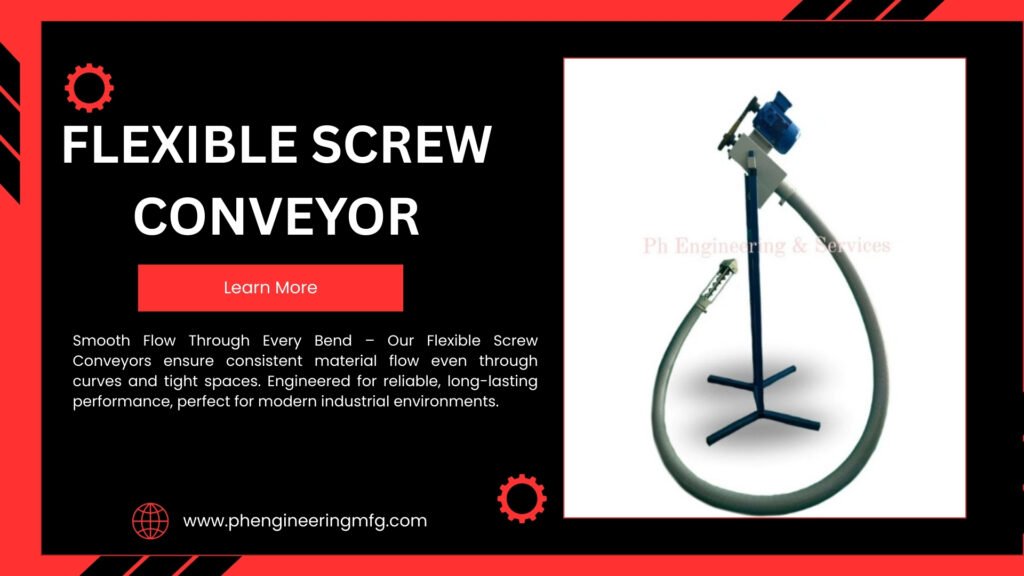
Flexible Screw Conveyors: The Ultimate Solution for Complex Material Routing
In industrial processing, not every facility layout is a straight line. When you need to move bulk materials around obstacles, handle delicate powders, or maintain a completely dust-tight environment, a rigid conveyor often won’t cut it. Enter the Flexible Screw Conveyor—the versatile powerhouse of material handling.
In this post, we’ll explore why “flexibility” is exactly what your production line might be missing.
What is a Flexible Screw Conveyor?
Unlike a traditional rigid auger, a flexible screw conveyor uses a high-strength, helically wound screw (the “spring”) that rotates inside a flexible, food-grade or industrial plastic tube. Because the screw itself is flexible, it can navigate curves and bends, allowing you to move material from a supply hopper to multiple discharge points with ease.
Why Choose a Flexible Design?
Obstacle Navigation: The biggest advantage is its ability to convey around walls, machinery, and other floor obstructions that would block a rigid conveyor.
Total Containment: Because the material moves through a sealed, flexible tube, there is zero dust emission—a critical requirement for chemical, pharmaceutical, and food-grade operations.
Easy Cleaning: These systems can be disassembled quickly for wash-down, preventing cross-contamination between product batches.
High-Speed Transfer: Despite their flexibility, they are capable of high-speed transport for powders, pellets, and granular materials.
Ideal Applications
Pharmaceuticals: Moving active ingredients without dust or environmental exposure.
Food Production: Ideal for transferring spices, flour, or additives into mixers.
Chemical Industry: Safely conveying powders from drums to processing units.
Batching Systems: Perfect for connecting a single storage hopper to multiple intake points on a line.
Design Considerations: Rigid vs. Flexible
| Feature | Rigid Screw Conveyor | Flexible Screw Conveyor |
| Path | Straight line only | Can bend/curve |
| Space | Large footprint | Compact, space-saving |
| Material | Abrasive, heavy loads | Powders, granules, light-duty |
| Dust Control | High | Excellent (Sealed) |
Maintenance Essentials
Monitor the “Spring”: The flexible screw will naturally undergo some wear over time. Periodic inspection of the screw’s diameter helps prevent “slipping” inside the tube.
Keep Bends Gentle: While flexible, avoiding overly tight radii (sharp bends) will extend the life of both the screw and the housing significantly.
Calibration: Ensure the drive unit is correctly aligned with the tube entry point to minimize vibration and noise.
Conclusion
A flexible screw conveyor is more than just a tube; it’s an engineering solution for tight spaces and complex layouts. By eliminating the need for rigid structural supports and multiple transfer points, it simplifies your material handling flow while keeping your facility clean and efficient.
Ready to modernize your material transport? Don’t let your facility layout dictate your production limits. Contact [PH Engineering] for a consultation on how a flexible screw conveyor can optimize your workflow.