Ribbon Blender (Ribbon Mixer): The Industry Standard for Precision Mixing
In the world of industrial processing, achieving a perfectly consistent mixture—whether you’re blending dry spices, pharmaceutical powders, or chemical additives—is essential for product quality. If your production line relies on blending multiple ingredients, you have likely come across the Ribbon Blender, also commonly known as a Ribbon Mixer.
Though the names are used interchangeably, they refer to the same robust, efficient, and versatile machine that has become a staple in manufacturing.
What is a Ribbon Blender (Ribbon Mixer)?
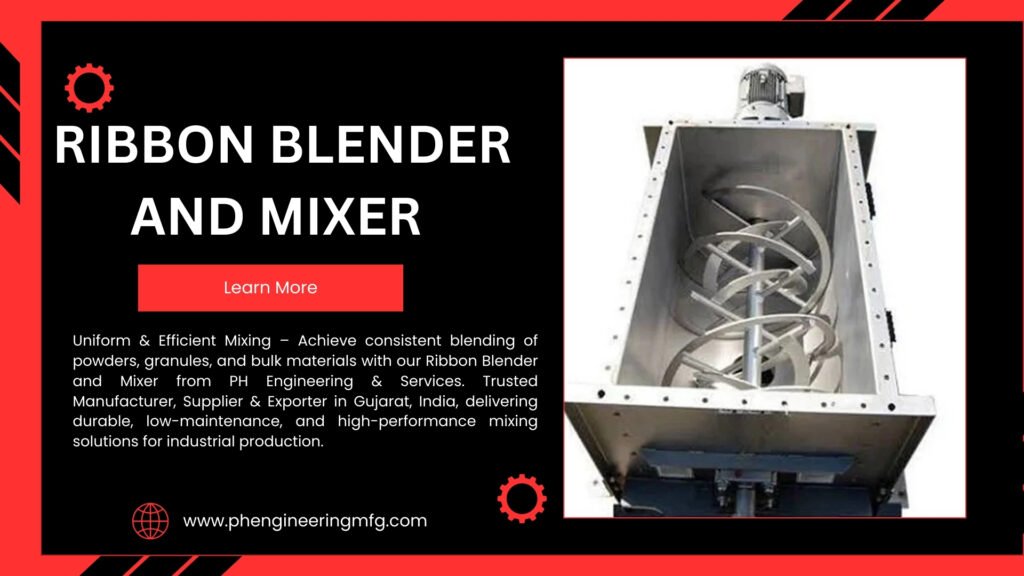
A Ribbon Blender is a horizontal mixing machine featuring a U-shaped trough and an agitator assembly consisting of an inner and an outer helical ribbon.
These ribbons are designed to move material in two directions simultaneously:
The Outer Ribbon: Pushes material from the ends towards the center of the trough.
The Inner Ribbon: Moves material from the center towards the ends.
This continuous “counter-flow” action ensures that ingredients are blended thoroughly, eliminating any dead zones and ensuring a highly homogeneous mix in a short amount of time.
Why Is It the Preferred Choice for Industry?
Whether you call it a blender or a mixer, the machine offers several key advantages:
Superior Homogeneity: The dual-ribbon design ensures that even minor ingredients are evenly dispersed throughout the batch.
Versatility in Materials: It handles everything from light powders and granular materials to semi-solids and paste-like ingredients.
Liquid Injection: Many Ribbon Mixers come equipped with spray bars, allowing for the precise addition of liquids to dry powders for uniform coating.
Scalability: From small-scale laboratory units (50 Liters) to high-capacity industrial machines (10,000+ Liters), it is perfect for any scale of operation.
Easy Discharge: Featuring bottom-discharge valves, the machine ensures quick and total unloading, minimizing product loss.
Common Applications
Food & Beverage: Spices, cake mixes, powdered drinks, and bakery premixes.
Pharmaceuticals: Blending dry active ingredients (APIs) and excipients.
Chemicals: Plastic resins, fertilizers, pigments, and detergents.
Construction: Blending dry mortar and cement additives.
Maintenance Tips for Optimal Performance
To get the most out of your Ribbon Blender, keep these maintenance tips in mind:
Seal Integrity: Inspect shaft seals regularly to prevent product leakage and dust contamination.
Ribbon Alignment: Ensure the clearance between the ribbons and the trough wall is consistent to prevent material buildup and energy loss.
Daily Sanitation: If you are in the food or pharma sector, implement a regular cleaning schedule. Many modern mixers offer “Easy-Clean” designs to simplify this process.
Final Thoughts
A Ribbon Blender (Ribbon Mixer) is more than just a piece of equipment; it is an investment in the consistency and quality of your brand. By choosing the right size and configuration for your specific material, you can significantly reduce batch cycle times and maintain perfect homogeneity in every run.
Looking for a high-performance Ribbon Blender for your production line? At [PH Engineering], we specialize in engineering industrial-grade Ribbon Mixers tailored to your specific processing needs.