Handling sticky, viscous, and high-moisture materials like municipal sludge, wastewater screenings, and industrial biosolids is one of the toughest challenges in process engineering. Traditional shafted screw conveyors often fail in these environments because sticky materials wrap around the center shaft, leading to severe blockages, severe mechanical strain, and unexpected plant downtime.
Engineers and plant managers facing these hurdles rely on shaftless screw conveyors to maintain continuous, trouble-free operations.
Why Traditional Screw Conveyors Struggle with Sludge
In standard conveyor designs, a heavy steel flight is welded around a central rotating pipe (the shaft). While this works exceptionally well for dry, free-flowing grains or powders, wet and stringy materials react poorly to the central geometry.
Material Buildup: Sludge, paper fibers, and municipal waste wrap tightly around the center pipe, forming a dense plug.
Bearing Failures: The buildup creates immense friction and unbalanced radial loads, forcing premature bearing and hanger failures.
High Maintenance: Clearing a choked shafted conveyor requires shutting down the entire line, locking out equipment, and manually digging out compacted waste.
The Engineering Advantage of Shaftless Designs
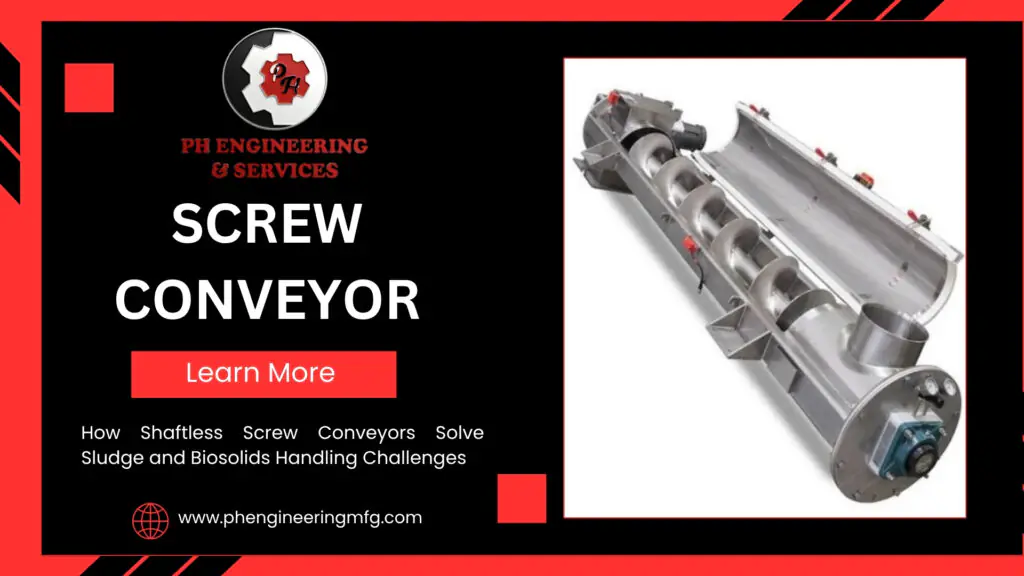
Shaftless screw conveyors completely eliminate the center pipe, replacing it with a heavy-duty, robust spiral (helix) that rotates freely within a lined trough. This open-center architecture changes how difficult materials move through the system.
Unrestricted Flow: Without a central core for material to cling to, sticky and heterogeneous substances slide smoothly along the conveyor trough.
Direct Contact with Liners: The heavy spiral rests on a low-friction wear liner (typically made of UHMWPE), pushing material forward efficiently without trapping waste.
Handling High-Moisture Loads: Designed specifically to manage materials with moisture content ranging up to 90%, making them ideal for dewatered sludge cakes and organic waste.
Key Applications in Wastewater and Industrial Plants
Municipal Wastewater Treatment: Transporting dewatered sludge from filter presses or centrifuges directly into haul-off trucks or incinerator feeds.
Food Processing Waste: Moving wet fruit and vegetable pomace, paunch manure, and slaughterhouse waste without choking.
Chemical and Pulp Slurries: Handling fibrous byproducts and viscous chemical pastes safely and cleanly.
Optimizing Your Bulk Material Handling Line
While shaftless screws excel at sticky waste streams, a complete industrial facility relies on a synchronized network of equipment. For dry raw materials upstream, integrating a precision Screw Conveyor ensures steady metering. When your process requires moving fine powders vertically between facility floors, pairing your horizontal waste lines with an efficient Bucket Elevator creates a seamless, fully enclosed transfer ecosystem. Similarly, if your facility blends dry additives with damp organic inputs upstream, a heavy-duty Ribbon Blender ensures homogeneous mixing before secondary processing.
Best Practices for Shaftless Conveyor Maintenance
To maximize the operational lifespan of your shaftless system, incorporate these routine checks into your plant maintenance schedule:
Monitor Liner Wear: Inspect the UHMWPE trough liners quarterly. Replacing worn liners early prevents the steel spiral from grinding against the metal trough housing.
Check Drive Alignment: Ensure the direct-drive gearmotor remains properly aligned to prevent torsional stress on the heavy spiral.
Control Infeed Consistency: Avoid introducing oversized foreign objects (like rocks or heavy scrap metal) that can jam the heavy-duty helix.
Upgrading to a shaftless design transforms a high-maintenance bottleneck into a reliable, automated link in your waste-processing infrastructure, drastically reducing operational headaches and repair costs.