
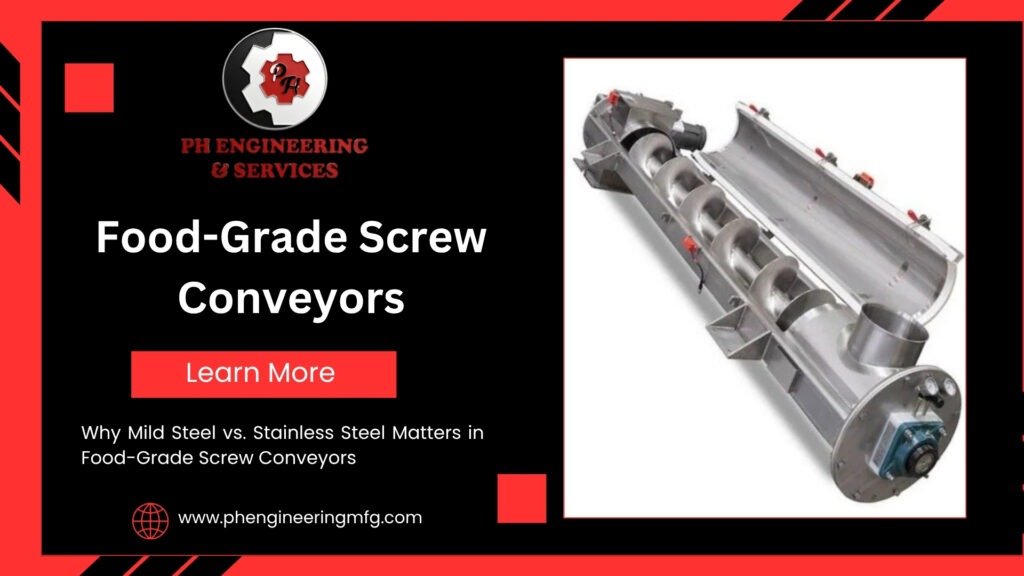
Designing or upgrading a material handling line for food processing, baking ingredients, or nutraceuticals requires adherence to strict sanitary standards. Beyond the mechanics of motor torque and flight pitch, the choice of structural metal alloy dictates whether your equipment passes safety audits or becomes a breeding ground for bacterial contamination.
While mild steel remains a cost-effective option for heavy industrial applications, food-grade processing demands a careful evaluation of mild steel versus stainless steel.
The Demands of Sanitary Bulk Handling
Food-grade environments present unique challenges: high humidity, frequent washdowns with aggressive sanitizing chemicals, organic residues, and zero tolerance for rust flaking. Conveyors handling flours, sugars, spices, and grains require surfaces that resist pitting and chemical degradation.
1. Mild Steel: Cost-Effective, But Limited in Food Processing
Mild steel is composed primarily of iron with a low carbon content, making it economical, highly durable, and easy to weld or machine.
The Advantages: Lower initial capital expenditure, high structural strength, and excellent performance in dry, non-corrosive heavy industrial sectors.
The Drawbacks: Highly susceptible to oxidation (rust) when exposed to moisture or cleaning acids. Over time, micro-pitting in the metal surface traps food particles, creating ideal environments for mold and bacterial growth (such as Salmonella or Listeria).
Best Use Cases: Only suitable in food plants if the conveyor handles sealed, outer-packaging containers or completely dry, non-reactive raw grains housed far away from washdown zones—though stainless steel remains the gold standard.
2. Stainless Steel: The Hygienic Standard (grades 304 & 316)
Stainless steel contains chromium, which forms a passive, self-healing oxide layer on the surface that prevents rust and withstands chemical corrosion.
Grade 304: The industry workhorse for food processing. Offers excellent resistance to organic acids, food juices, and routine sanitization washdowns.
Grade 316: Features added molybdenum, providing superior resistance to chlorides and harsher chemical washdowns used in dairy, meat processing, and high-salinity applications.
Surface Finishing: Stainless steel can be ground, polished, and bead-blasted to an ultra-smooth finish (low Ra value), preventing material adherence and making clean-in-place (CIP) protocols vastly more effective.
Integrating Food-Grade Conveyors Into Your Plant Layout
Selecting sanitary metallurgy is only one piece of a clean production ecosystem. When designing a multi-stage food plant, your horizontal transfer systems must integrate cleanly with vertical and blending equipment. For instance, feeding dry spices or baking mixes safely from a sanitary storage hopper requires an enclosed, easy-to-clean Screw Conveyor constructed entirely from polished stainless steel.
If those ingredients must be lifted to an overhead packaging mezzanine without risk of contamination or dust leakage, pairing your feeder with a sealed, food-safe Bucket Elevator maintains total product integrity. Furthermore, if your process involves blending multiple dry food powders uniformly prior to bagging, a precision-engineered Ribbon Blender with food-grade internal welds eliminates dead zones where cross-contamination can occur.
Key Takeaways for Plant Engineers
Evaluate Washdown Fines: If your facility uses high-pressure caustic washdowns daily, mild steel will degrade rapidly. Invest in Grade 304 or 316 stainless steel from day one.
Prioritize Finish Quality: Specify continuous, ground, and polished internal welds on your screw troughs to eliminate microscopic crevices where food particles hide.
Protect Your Brand: Preventing rust flakes and microbial contamination safeguards your product quality, protects consumer safety, and ensures seamless compliance with regulatory bodies like FDA and FSSAI.