
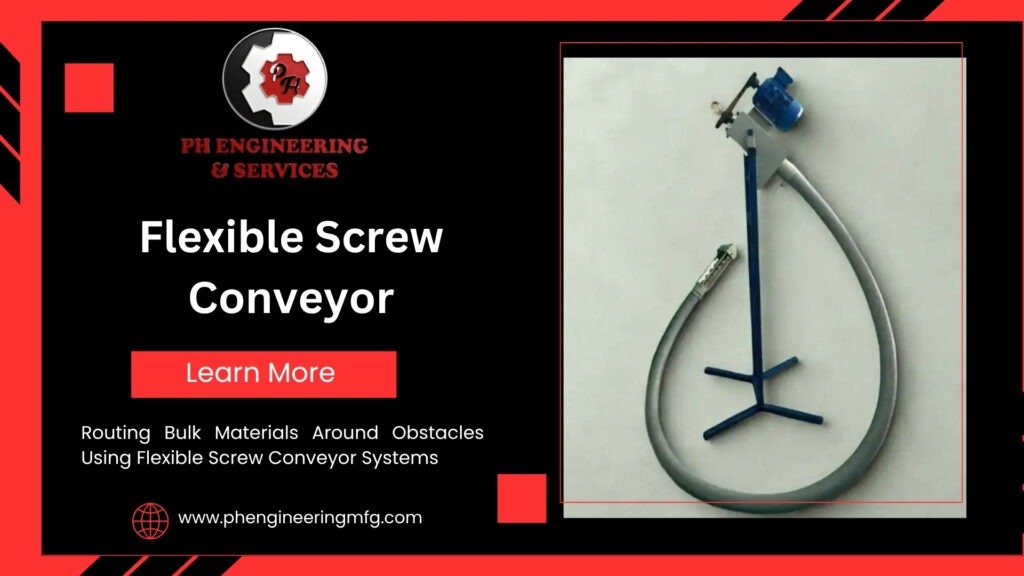
Laying out a new processing line or retrofitting equipment into an existing manufacturing facility rarely happens in a wide-open, empty space. Plant engineers constantly face a maze of structural pillars, overhead pipes, mezzanine supports, and tight corners. Traditional rigid conveyors demand straight lines, requiring multiple transfer points, junction hoppers, and extra drive motors to navigate room constraints.
Facilities needing to bypass complex layout obstacles rely on flexible screw conveyor systems to maintain a continuous, single-drive material path.
The Constraints of Rigid Conveying Lines
Rigid mechanical systems—such as standard troughs or straight pipe augers—operate efficiently in linear paths, but introducing bends creates severe design bottlenecks:
Multiple Transfer Junctions: Changing direction with rigid equipment requires dumping material from one conveyor into a transition hopper, then feeding it into a second independent machine.
Elevated Capital and Maintenance Costs: Every extra transfer point adds wear components, requires separate electrical hookups, and increases potential points of dust leakage or mechanical failure.
Space Consumption: Rigid multi-stage setups consume valuable floor space, complicating operator movement and routine plant maintenance.
How Flexible Screw Conveyors Overcome Layout Barriers
A flexible screw conveyor replaces rigid metal housings with a tough, high-density polymer tube that can bend and curve within engineering radius limits. This design introduces unique routing capabilities:
Single-Drive Multi-Plane Routing: A single motor and rotating inner spiral can transport materials horizontally, at an incline, and around sweeping directional curves without intermediate transfer points.
Space-Saving Footprint: The ability to snake around building columns and overhead obstacles allows plant layouts to maximize vertical and horizontal space usage.
Enclosed Protection: Bending the casing does not compromise dust containment, keeping hazardous or fine-particle ingredients completely sealed throughout the journey.
Integrating Flexible Routing Into Your Plant Layout
Streamlining your plant architecture often requires combining flexible routing with heavy processing machinery. For instance, if your intake hopper sits in a cramped corner away from your primary mixing vessel, routing a flexible Screw Conveyor around structural pillars delivers raw powders cleanly into a heavy-duty Ribbon Blender without requiring a messy multi-stage transfer system.
Similarly, if your blended product needs to move from a ground-floor packaging line up to an elevated storage mezzanine, pairing your curved routing path with a robust vertical Bucket Elevator or a high-angle flexible auger completes the circuit efficiently.
Key Design Considerations for Routed Systems
Respect Minimum Bend Radii: Never force a flexible tube past its specified minimum radius; doing so causes excessive friction against the inner spiral, accelerating wear and placing undue strain on the drive motor.
Assess Material Abrasiveness: While flexible augers excel at handling free-flowing powders, highly abrasive minerals can wear out polymer casing walls faster along high-friction curve points.