Lifting dry bulk materials vertically to elevated storage bins or processing mezzanines is a fundamental requirement in modern industrial plants. However, choosing the wrong type of vertical lifting mechanism can lead to severe product degradation, crushing, and excessive fines generation—especially when handling delicate food items, roasted coffee beans, fragile chemical pellets, or brittle pharmaceutical crystals.
When designing a vertical transfer line, engineers must weigh the operational differences between centrifugal discharge and continuous bucket elevators.
1. Centrifugal Bucket Elevators: High-Speed, High-Capacity Lifting
Centrifugal bucket elevators are the most common and cost-effective style for rugged, free-flowing materials like sand, gravel, cement, and standard agricultural grains.
The Mechanism: Buckets are spaced apart on a belt or chain. As they pass around the head pulley, high rotational speed uses centrifugal force to fling material outward and upward into the discharge chute.
The Advantages: High throughput capacity, smaller footprint, and lower initial capital investment for heavy industrial minerals.
The Limitations: The high-speed throwing action and impact against the discharge hood cause severe breakage, making them completely unsuitable for fragile or delicate products.
2. Continuous Bucket Elevators: Gentle Vertical Transport
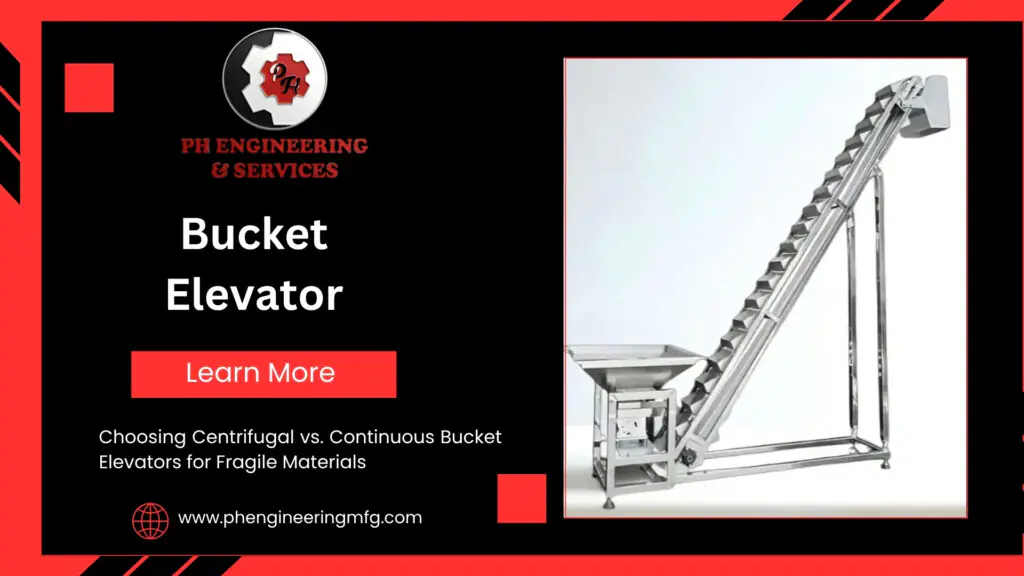
Continuous bucket elevators are specifically engineered for delicate materials that cannot withstand high-speed impacts or violent centrifugal discharge.
The Mechanism: Buckets are mounted edge-to-edge with no gaps between them on a slow-moving belt or double chain. As the buckets invert over the head sprocket, the back of the preceding bucket acts as an extended slide chute for the material emptying above it.
The Advantages: Zero impact damage and gentle gravity discharge prevent product fracturing, dusting, and separation of blended ingredients.
The Limitations: Slower operating speeds and closer bucket spacing mean a larger physical casing size is required to achieve equivalent volume throughput compared to centrifugal units.
Integrating Vertical Lifts Into Your Plant Layout
Protecting product integrity requires ensuring that your vertical lift synchronizes seamlessly with your horizontal conveying and mixing equipment. For instance, after gently hoisting fragile flakes or food ingredients using a continuous Bucket Elevator, discharging the material smoothly into a precision horizontal Screw Conveyor prevents secondary impact damage.
Similarly, if your process routes raw ingredients through an upstream batch-compounding phase, mixing inputs thoroughly inside a heavy-duty Ribbon Blender before elevating them ensures that your delicate final blends arrive at the packaging station completely uniform and undamaged.
Best Practices for System Specification
Match Bucket Design to Material Density: Select food-grade polyethylene, nylon, or heavy carbon steel buckets based on chemical compatibility, hygiene requirements, and material abrasiveness.
Control Infeed Loading: Equip your elevator boot with a regulated rotary feeder or metered screw intake to prevent overfilling and bucket clipping during operation.