
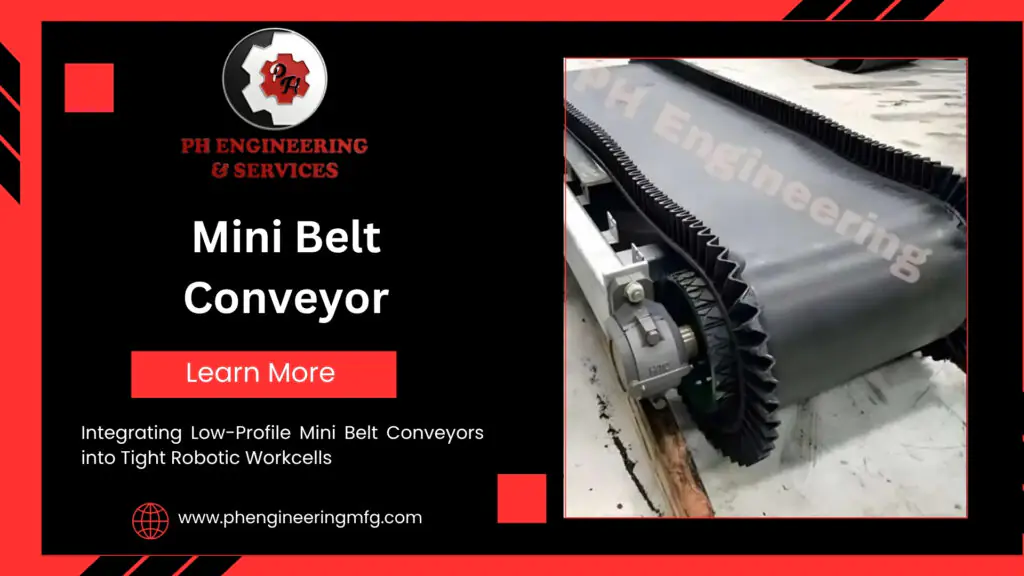
Modern manufacturing and high-speed packaging lines rely heavily on automated robotic workcells to pick, sort, and assemble small components with pinpoint accuracy. However, traditional heavy-duty conveyor systems are often too bulky to fit within the restricted operating envelopes of robotic arms. Installing oversized equipment restricts movement, creates safety clearance hazards, and slows down cycle times.
To overcome these constraints, plant engineers integrate low-profile mini belt conveyors directly into tight robotic workcells to streamline small-part handling without sacrificing floor space.
The Challenge of Space Constraints in Automation
In precision assembly—whether handling small molded plastics, electronic components, or delicate pharmaceutical items—every millimeter of workspace matters.
Interference Zones: Standard-profile conveyors feature bulky side frames and under-mounted gearboxes that collide with robotic swinging radii.
Indexing Precision: Small parts require precise positioning beneath optical sensors and robotic grippers; erratic movement leads to dropped items and sorting errors.
Maintenance Access: In cramped multi-robot layouts, cumbersome equipment makes routine belt replacements or sensor cleanings difficult.
Why Low-Profile Mini Belt Conveyors Excel
Mini belt conveyors are engineered specifically for compact footprints, offering distinct mechanical advantages for automated environments:
Ultra-Thin Bed Extrusions: Low-profile aluminum or stainless steel bed designs minimize vertical height, allowing the conveyor to slide neatly beneath robotic tooling or inside tight enclosure frames.
Precision Speed Control: Equipped with variable frequency drives (VFDs) or step motors, mini belts provide smooth, highly repeatable indexing to synchronize perfectly with robot pick-and-place cycles.
Versatile Material Handling: Smooth, low-friction belts prevent delicate small parts from scratching, jamming, or tumbling out of place during transfer.
Integrating Mini Belts Into Your Broader Production Line
While mini belt conveyors dominate fine-part assembly and sorting zones, they often serve as the final transfer link in a much larger, heavy-duty processing ecosystem. For instance, after delicate molded components or small fasteners are sorted on a robotic mini belt line, upstream bulk raw materials are frequently metered and fed using an industrial Screw Conveyor.
If those raw ingredients require vertical elevation before reaching the assembly or packaging stage, pairing your system with a robust Bucket Elevator ensures steady overhead transport. Furthermore, if your manufacturing process involves compounding raw polymer powders or chemical additives prior to molding, mixing materials uniformly inside a heavy-duty Ribbon Blender guarantees that your final small-part output maintains consistent material quality.
Best Practices for System Integration
Select the Right Belt Surface: Choose anti-static or high-friction belt materials depending on whether your application requires static dissipation for electronics or secure grip for inclined transfers.
Position Optical Sensors Carefully: Mount part-detection photo-eyes closely to the drop-off point to ensure seamless handoffs between the mini belt and robotic grippers.