
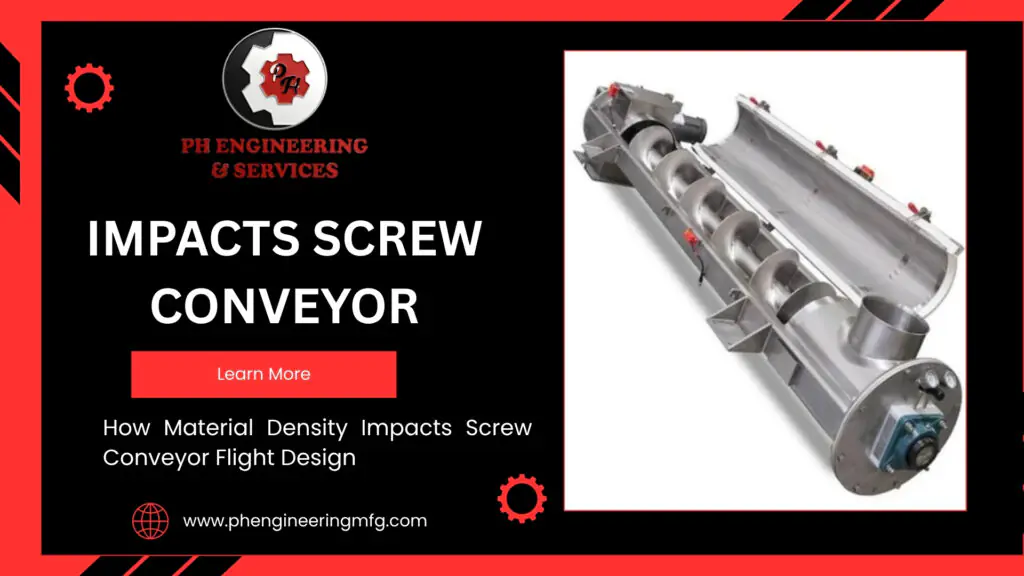
When specifying an industrial screw conveyor, many engineers focus primarily on volumetric capacity—how many cubic meters or liters per hour need to be moved. However, ignoring the physical weight of the product can lead to catastrophic mechanical failures, severe shaft deflection, or motor burnouts.
Bulk density (measured in pounds per cubic foot or kilograms per cubic meter) is the single most critical factor determining how a Screw Conveyor must be mechanically engineered, particularly regarding its flight design, thickness, and material composition.
1. Why Bulk Density Dictates Torque and Motor Sizing
The density of your material directly dictates the load placed upon the rotating screw helix.
Light Materials: Products like wood shavings, fine grain handled by a Grain Loader Machine, or light powders exert minimal resistance against the flights. They require standard torque and lighter motor ratings.
Heavy Materials: Materials like wet sand, metallic powders, heavy chemicals, or dense minerals add massive torsional stress. If the flighting and shaft are not sized to withstand the high weight load, the internal shaft can twist or snap under pressure.
2. Flight Thickness and Material Selection
Standard screw conveyor flights are typically formed from flat sheet metal shaped into a helix. As material density increases, the mechanical wear and physical pressure on the outer edges of the flights multiply exponentially.
Mild Steel vs. Heavy-Duty Alloys: For light to moderate bulk densities, standard mild steel or light stainless steel flights are sufficient. However, for dense, abrasive materials, manufacturers must upgrade to thicker gauge metals or abrasion-resistant alloy sheets (such as Hardox or AR400).
Hard-Facing for Extreme Densities: When handling heavy, abrasive minerals, standard steel flights wear down rapidly at the outer perimeter. Applying a hardened weld overlay (hard-facing) along the outer edge of the flighting ensures the conveyor maintains its pushing efficiency over years of continuous operation.
3. Pitch-to-Diameter Ratios and Density Matching
The spacing between each loop of the screw (known as the pitch) must also be engineered in response to material weight and flow characteristics:
Standard Pitch (1:1 Ratio): Best suited for average-density, free-flowing materials, providing a balanced trade-off between speed and pushing force.
Short Pitch: For extremely heavy or fluid-like materials that tend to flood the trough, a short pitch (shorter distance between flights) reduces the volume of material lifted per revolution, preventing the motor from stalling.
Integrating with Processing Systems: If your high-density powders are being discharged from heavy-duty equipment like a Ribbon Blender or lifted via a Bucket Elevator, the transition points must account for material compaction. Sudden density changes from settling can choke a standard screw feeder if the flight spacing isn’t uniform.
4. Key Takeaways for Engineers and Plant Operators
When requesting a custom industrial conveyor quote, always provide your material’s exact bulk density (both aerated and packed). Designing a screw conveyor with the correct flight thickness, pitch, and shaft diameter ensures:
Extended Asset Lifespan: Preventing premature thinning or tearing of the flight edges.
Energy Efficiency: Matching the motor horsepower precisely to the weight load without drawing excess current.
Smooth, Continuous Flow: Eliminating material packing, bridging, or dead zones.
Need Help Sizing Your Screw Conveyor?
Every bulk material behaves differently under load. Whether you are moving light agricultural grains, heavy industrial chemicals, or packaging fine powders using a Flexible Screw Conveyor, getting the engineering right from the start saves thousands in maintenance costs.
Contact PH Engineering today to consult with our technical team on custom-built screw conveyors designed specifically for your material’s density and flow requirements.